The Silicon Six and their widening $300bn global tax gap

In November 2026, the Fair Tax Foundation published a report, The Silicon Six and their widening $300bn global tax gap, the long-run effective tax rate of the Silicon Six (Alphabet/Google, Amazon, Apple, Meta/Facebook, Microsoft and Netflix) over the past decade. It is a variation of analysis we last undertook in 2025, 2019 and 2021.

These businesses dominate digital infrastructure and services across many parts of the world, and increasingly the infrastructure of artificial intelligence. Together, they have a combined market capitalisation of $16.7tn, more than one and a half times the entire FTSE 100 and EURO STOXX 50 combined.
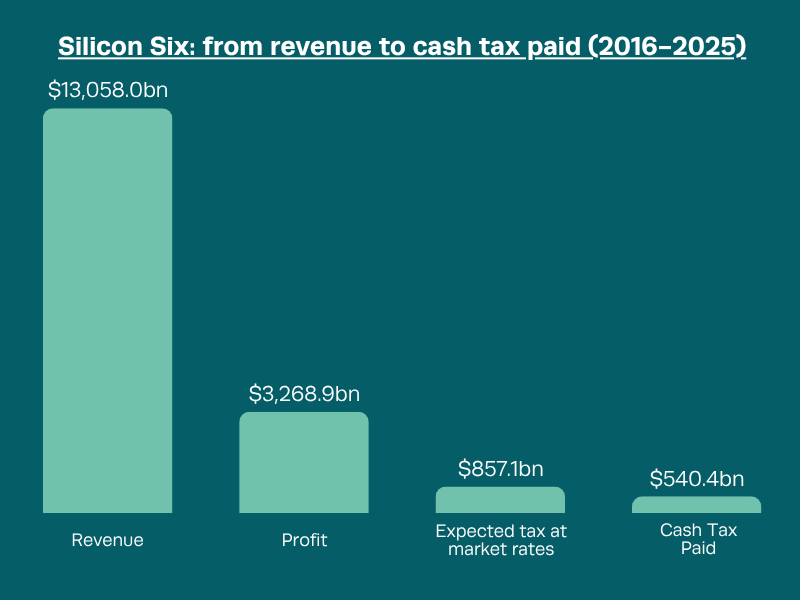
Over the past ten years, the Silicon Six have generated $13.1tn of revenue and $3.3tn of profits, yet paid just 16.5% of those profits in corporate income tax in cash, at a time when the combined corporate income tax rate averaged 28.4% in the US and 26.6% worldwide. Had their profits been taxed at the headline rates applying where their customers are located, they would have paid $316.7bn more over 2016–2025.

In 2025, five of the six recorded their highest profit margins in a decade, and their combined profits rose by 29.4% to $680bn. Yet their cash tax contribution crashed to just 12.3% of profits – the lowest in the ten years covered by the report – with Amazon and Meta paying less than 9%, tax-haven-like rates.

For the first time since the Fair Tax Foundation’s analysis began in 2019, Amazon are no longer ranked as the business with the poorest tax conduct: Meta now firmly exceed it. The 2026 ranking of worst tax conduct is as follows:

  • 1st Meta (Facebook)
  • 2nd Amazon
  • 3rd Alphabet (Google)
  • 4th Netflix
  • 5th Apple
  • 6th Microsoft

Meta’s cash tax over 2023–2025 was just 12.1% of profits, the lowest of the six, and only 8.8% in 2025; their effective tax rate over the first three-quarters of 2026 was just 2%. They earn 63% of their revenue outside the US but book only 7% of profit there, and face a $15.9bn claim from the US Internal Revenue Service over the transfer of their intellectual property to Ireland.

Amazon remain a very close second: they have paid just $46.7bn of corporate income tax in cash over the decade on $4.1tn of revenue, against $140.0bn paid by Microsoft on less than half that revenue.

Report recommendations

It is suggested that the EU (and its Member States) and the UK:

  • Convene special commissions to establish the tax contribution of Big Tech and the wider digital economy.
  • Consider a Market Profits Levy on profits generated by European customers but booked elsewhere.
  • Public procurement, including under the proposed EU Public Procurement Act, be allowed to take account of corporate tax conduct (at both a national and local level).

Given that US federal corporate income tax receipts fell by $70bn (16%) in fiscal year 2026, it is further suggested that the United States:

  • Repeal its FDDEI tax break (formerly FDII), which taxes profits from serving foreign customers at around 14% and has been worth at least $48.1bn to the Silicon Six since 2018.
  • Apply its minimum tax on foreign income country by country at no less than 15%, in line with the global minimum tax it helped to design.
  • Pair full expensing with tighter limits on interest deductions, so that debt-financed data centres are not effectively subsidised.

Silicon Six: from revenue to cash taxes paid (2016 – 2025)

Alphabet/GoogleAmazonAppleMeta/FacebookMicrosoftNetflixTotal
Revenue ($bn)2283.14126.834591015.71912.7260.713058
Booked profit ($bn)700.4292.81027.3396.6804.647.23268.9
Current tax provision ($bn)122.852.8176.166.3156.37.8582.1
Current tax provision / booked profit17.5%18%17.1%16.7%19.4%16.6%17.8%
Cash income tax paid ($bn)120.346.7169.956.21407.3540.4
Cash tax paid / booked profit17.2%15.9%16.5%14.2%17.4%15.5%16.5%
Cash tax paid / revenue5.3%1.1%4.9%5.5%7.3%2.8%4.1%
Current tax provisions and cash tax paid both exclude the share of US transition tax ($965) attributable to earnings before 2016 and Apple's EU State Aid charge and payment, which relate to profits earned before the period under review.

Support our mission

Latest News

Open book on stack of books against wood background

New global guide for business recommends Fair Tax Mark

A global research project are calling on companies to commit to take action on fair tax. And they recommend the Fair Tax Mark as a way to do so. The Embedding Project are a global research project working for the common good to help companies embed sustainability across their operations and decision-making. Their recent guide, Fair Tax: A Getting Started …

Read more

Royal London largest financial institution to achieve Fair Tax Mark

Royal London, the UK’s largest customer-owned life, pensions and investment company, have achieved the Fair Tax Mark, joining 275 businesses worldwide recognised for paying the right amount of tax, in the right place, at the right time. Awarded by the not-for-profit Fair Tax Foundation, the Fair Tax Mark is widely recognised as the gold standard for responsible tax conduct. To …

Read more

Fair Tax Foundation pCbCR research expands to 650 multinationals as Spanish filings surge

Greg Yates, senior ratings manager, Fair Tax Foundation   Chloe Almond, research analyst, Fair Tax Foundation The Fair Tax Foundation have more than doubled the number of multinational enterprises covered by our research into implementation of the EU Public Country-by-Country Reporting Directive – from just over 300 in June 2026 to 650 at the end of September. Our newly updated …

Read more

Thinking about Fair Tax Mark certification for your business? Enquire Here
Fair Tax Foundation
Privacy Overview

This website uses cookies so that we can provide you with the best user experience possible. Cookie information is stored in your browser and performs functions such as recognising you when you return to our website and helping our team to understand which sections of the website you find most interesting and useful.