You’re hired! Responsible tax wins over workers

People want to work at companies that pay tax responsibly. It’s something the public have told us in surveys and through companies coming to us for the Fair Tax Mark over the past ten years.

But now – in an evolving labour market in which staff shortages are an increasing concern – this is being put to the test and studies are finding that aggressive tax practices can actually be detrimental to recruitment.

For employers, being a responsible corporate taxpayer is no longer just a nice to have. It’s essential to good business.

Employees are good for business

In the age of artificial intelligence, it is worth stating the importance of employees for business. Not only do evolving industries and labour shortages make attracting talent a pressing concern, but also employee satisfaction is strongly linked to business performance.

A Global Happiness and Wellbeing Policy Report in 2019 found higher wellbeing is associated with increased productivity (about a 10% average gain), greater customer satisfaction, lower staff turnover and better financial outcomes. A literature review the previous year yielded similar results.

It is in this environment that good corporate tax practices are shown as desirable to employees and job seekers and may even impact recruitment.

Fair Tax Mark businesses know the importance of their employees, and how responsible tax practices demonstrate this. “Ensuring our standards towards tax are the highest they can be is just one way we can demonstrate to our customers and colleagues our commitment to being a responsible organisation,” James Timpson, former CEO of Timpson Group said when they achieved their Fair Tax Mark.

“The Fair Tax Mark helps us communicate with our stakeholders significantly, including within the company. It becomes clear to all employees and applicants that we take our values of being fair, sustainable and responsible seriously and live by them.”

Peter Ledermann, Executive Board Member

Unite_logo-landscape_gradient_RGB

What do workers want?

Corporate tax avoidance is not a good look. In the United States, research among the S&P 500 in 2021 found that employee perceptions of managers and firms fall following tax avoidance news coverage, with firms in consumer-facing industries suffering the largest perception changes.

People want to know what companies are up to when it comes to tax. A Fair Tax Foundation survey in 2025 found that 78% of the UK public said UK companies of all sizes should have to publicly disclose their tax policies and clarify their attitude to tax avoidance. This was up from 75% the previous year.

But do a company’s corporate tax practices actually influence the behaviour of employees or potential employees?

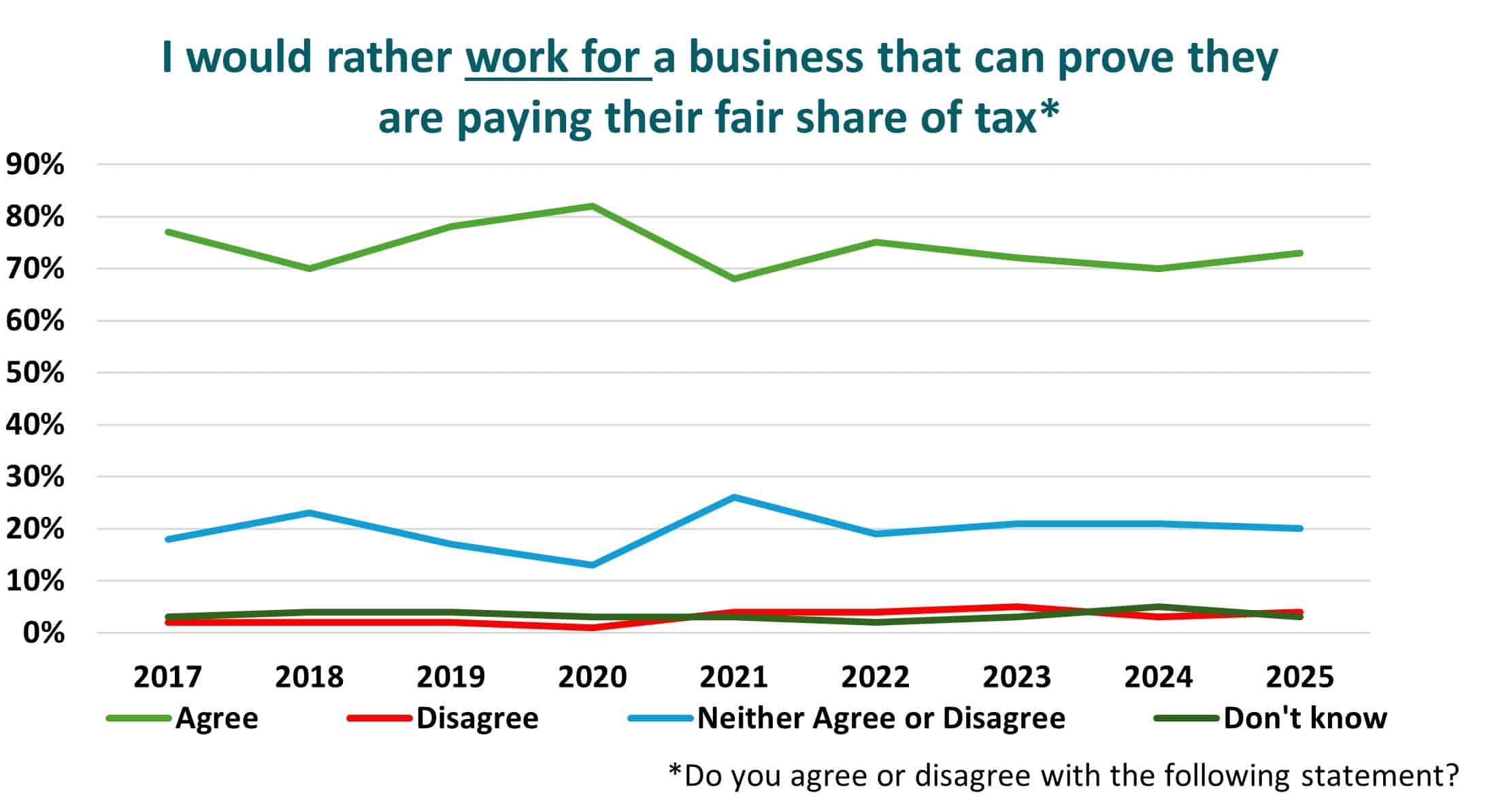
For the past ten years, the Fair Tax Foundation have commissioned polling in the UK on various aspects of corporate tax conduct. The survey has consistently found the majority of the UK public would rather work for a business that can prove it is paying its fair share of tax.

In 2025 this figure was 75% of respondents, up from 70% the year before.

Attracting talent

Taking this further, a 2025 study found corporate tax aggressiveness may in fact harm a company’s recruitment drive. It looked at 439 final year students in Belgian universities studying a mix of tax and non-tax-related subjects and found that although tax avoidance was not as detrimental to recruitment as tax evasion, it could still have a negative impact because jobseekers were less likely to recommend the tax-avoiding firm to others.

“Tax avoidance could still backfire through missing out on positive word-of-mouth,” one of the report authors, Kenny Dekoster, said.

Stronger still are the findings from a study published just weeks after Dekoster’s. Using a factorial survey experiment, these researchers found that job applicants view companies that engage in aggressive tax avoidance or evasion as less attractive and are less likely to accept offers from them compared with firms using responsible tax strategies.

However, this was tempered by a perception of unfairness of the tax system. The study found job applicants are more tolerant of aggressive tax avoidance or even tax evasion if the tax system is seen to be unfairly disadvantageous to the prospective employer. This has been found in other research, alongside another big factor: pay.

Even our own surveys find pay to be the biggest consideration at a company, which makes complete sense for jobseekers. But others have found that employees are willing to accept lower wages to work in highly socially responsible companies, and are likely to avoid working at companies with tax-avoiding practices unless they are being better compensated for it. But it can also be harder to bargain for higher wages, benefits and treatment at tax-avoiding firms, because their finances are often more opaque.

“Transparency and integrity are fundamental to building trust with our colleagues.”

Simon Kirkpatrick, CFO

Mitie transparent

The UK cleaning industry employs 1.47 million people and in 2021 contributed £59.8bn to the country’s economy, according to the British Cleaning Council, and yet the sector is plagued by increasing staff shortages (thought to be as high as 40%, compared with 20% in other sectors), high turnover and low retention rates.

The Fair Tax Mark is one way businesses in the sector can hope to attract and retain employees, given that the vast majority of the UK public said they would ‘rather work for a business that can prove that it’s paying its fair share of tax’. Sentiment was slightly stronger among women (75%), who make up a slightly greater proportion of the UK’s cleaning workforce, at 58%.

Restoring dignity

One cleaning company that sees the value responsible tax conduct can have for their staff is Clean For Good (CFG), a professional cleaning company for workspaces, based in London. They employ more than 75 cleaners and were the first cleaning company in the UK to become Fair Tax Mark accredited.

“In a sector where low pay and poor working conditions are widespread, we have a mission to provide fair pay and restore dignity to our cleaning staff, while at the same time provide an excellent service to our clients,” said Charlie Walker, CFG Managing Director.

“We are passionate about the way we do business, not just the financial outcomes our businesses generate.”

Proud to pay tax

Most cleaning businesses are small, with nine out of ten employing fewer than ten people. At present, the vast majority of small companies in the UK choose to publish filleted and / or abridged accounts at Companies House. In effect the only financial information disclosed is a scaled down balance sheet account – there is no information on income, profit or taxes paid.

CFG are proud to say what they pay in tax and want every part of their business model to be an exemplar of responsible business.

“The fair tax accreditation was an opportunity to demonstrate that we take the question of how we run the business, seriously,” Walker continued.

In a sector where transparency is a key challenge, Walker concluded: “The fair tax accreditation helps us to lead and influence the cleaning sector for good.

“And that really is what we are all about!”

Read Clean for Good’s Sector Special here

Being a responsible taxpayer

Increased transparency is making it easier to lift the lid on companies’ tax practices. And potential employees want to do just that and then pass on their recommendations to others.

That means jobseeker preferences are having a real impact on business recruitment – a concern for many in the current climate.

Employees at Fair Tax Mark companies are proud to work for responsible corporate taxpayers – they use Fair Tax mugs, wear Fair Tax hoodies, and get together to celebrate Fair Tax Week.

So if your business is looking to attract and retain the best talent, then responsible tax practices are a no-brainer.

Latest News

LEAP add Fair Tax Mark to responsible credentials

Design and impact agency LEAP have been awarded the Fair Tax Mark. This means they operate at the highest level of business tax conduct. LEAP provide branding and digital services, as well as strategy and consultancy. Their clients include Tilda, the UK Space Agency and Divine Chocolate. Sustainability and good business are at the centre of their ethos, meaning their …

Read more

Deeply rooted tree demonstrated social enterprise values

Sector special: Fair Tax Mark shows social enterprise values ‘deeply rooted’

In this series for the Fair Tax Foundation, our certified organisations tell us how the Fair Tax Mark has helped open opportunities or overcome challenges specific to their sector.  Here, Abbas Shapuri, chartered accountant at Third Sector Accountancy, shares why the Fair Tax Mark is so important for a sector rooted in achieving social goals: social enterprises. For social enterprises, social and environmental …

Read more

Fair Tax Week 2026: Save the dates

We’re delighted to announce this year Fair Tax Week will take place 21-28 June. Tax Justice Sunday will be on the last Sunday, 28 June.

Fair Tax Week is an annual awareness-raising week celebrating the importance of businesses paying corporate income tax responsibly.

Read more

Thinking about Fair Tax Mark certification for your business? Enquire Here
Fair Tax Foundation
Privacy Overview

This website uses cookies so that we can provide you with the best user experience possible. Cookie information is stored in your browser and performs functions such as recognising you when you return to our website and helping our team to understand which sections of the website you find most interesting and useful.