
Corporate income tax contribution across the world is the highest this century
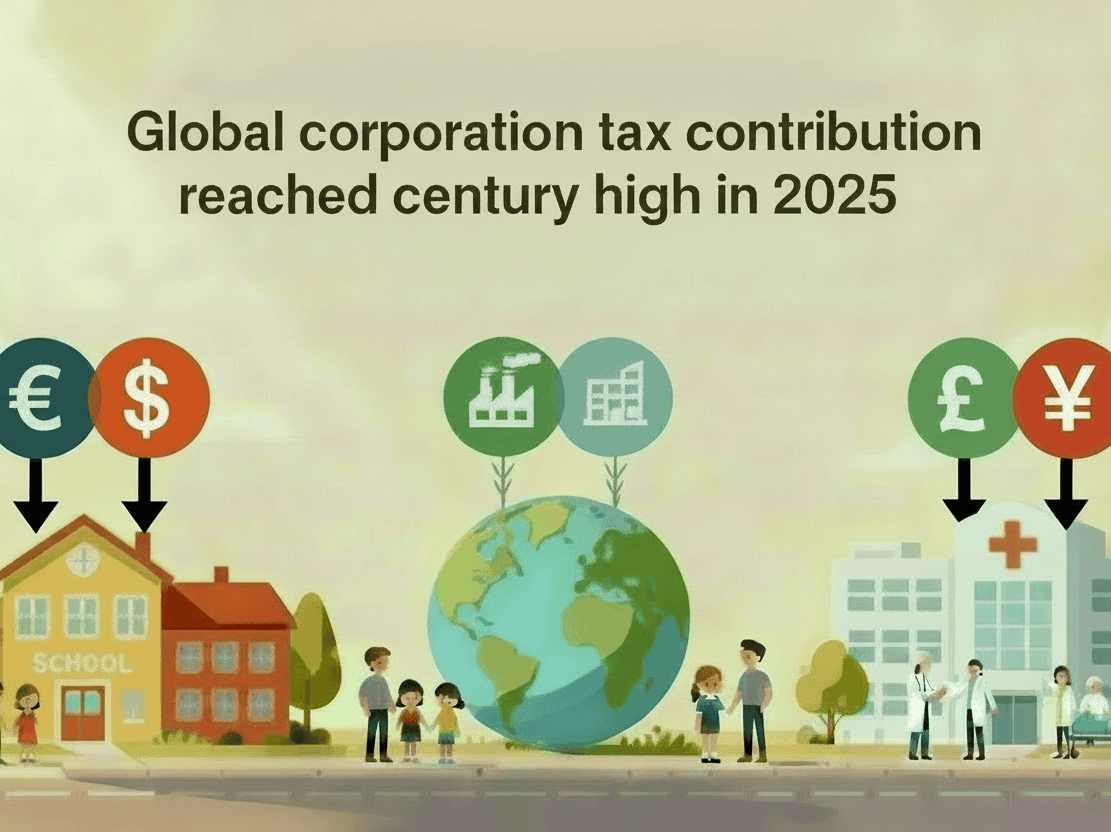
Corporation tax is an increasingly crucial source of revenue to governments across the world.
The OECD has just released their latest annual analysis of what’s happening with corporate income tax across the world, and there is much to celebrate.
The OECD’s Corporate Tax Statistics 2025 reports that the global contribution of corporation tax revenues to overall tax revenue has again grown substantially, and accounts for 17.8% of all tax revenues raised.1 This is the highest percentage contribution recorded since OECD analysis commenced in 2000, when it stood at 12.4%.
The contribution made by corporation tax is even higher in Africa and Asia & Pacific, where they account for 21% of tax raised.2 In 26 countries, corporate tax revenues now make up more than one-quarter of total tax revenues (a substantial increase on the 17 jurisdictions where this happened the previous year). In twelve countries – Bhutan, Chad, Cuba, Democratic Republic of the Congo, Equatorial Guinea, Hong Kong (China), Malaysia, Nigeria, Norway, Papua New Guinea, Timor-Leste and Trinidad and Tobago – it accounted for over 40% of revenue.
In related disclosures, the OECD is also reporting that the average tax-to-GDP ratio for Africa has risen for the third consecutive year, and that this increase was driven by higher revenues from corporate income tax for a second consecutive year.3
Average rate of corporation tax increases for a third year
The average global corporation tax rate in 2025 has increased slightly for a third consecutive year, and now stands at 21.1% globally.4
For the second-year running, more jurisdictions increased their rate (four5), than decreased their rate (three6) in 2025.
The global race to the bottom on headline corporate income tax rates that took place over recent decades looks to have ended, with hints that it may even be reversing. The advent of the 15% Global Minimum Tax seems to be helping, not hindering, this reverse. However, the global average is still some way behind the 28% that it was at the turn of the century; and, in 2025, 11 jurisdictions still had no corporate tax regime or a headline rate of zero.
Base erosion and profit-shifting by multinationals are reducing
Over the last two years, OECD analysis has become much more upbeat around the curtailment of aggressive tax avoidance by multinationals. Back in 2023, they emphasized that “the data continues to point to the existence of base erosion and profit shifting… and continues to show a misalignment between the location where profits are reported and the location where economic activities occur.” But in 2025, they draw attention to how the data now suggests “modest reductions in base erosion and profit shifting in recent years”7 – albeit with continued evidence of avoidance enablement in investment hubs (such as Malta, Switzerland and Ireland).
Cause for hope and optimism
Two trends seem to playing out. Firstly, governments have broadening the base to which corporation tax applies and have clamped down on tax avoidance – which has driven up payments as a percentage of all taxes raised. Secondly, the race to the bottom on the headline rate of tax seems to have ended , and has even grown slightly in recent years. This is to be celebrated.
Only a few years ago, it was not unusual to hear business commentators happily predict the demise of corporate income tax. However, such talk is now rare in mainstream conversations given the enormous sums of money it raises. For example:
- Fair Tax Mark accredited businesses alone contribute some €6bn / £5bn annually
- profit taxes made up 53% of all taxes borne by large multinationals headquartered in Europe8
- in the UK, corporate income tax contributes over £100bn per annum9
However, there is no room for complacency. Further improvements are by no means guaranteed. The Trump administration in the United States is doing its utmost to unwind recent progress, with attacks on: the very idea of a corporate global minimum tax; and, the improvement of long-discussed FASB corporate tax transparency standards. Albeit, to date, both are still rolling out and are having a substantive, positive impact.
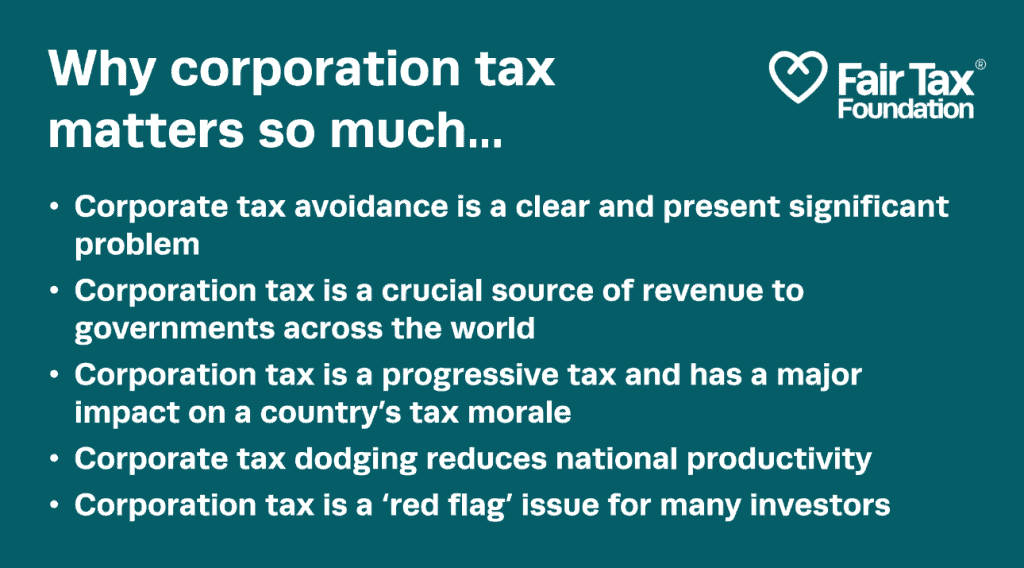
Corporation tax is much more than a revenue raiser for public services. No other tax borne or collected by business comes close to having such an impact. Which isn’t to say that other taxes are unimportant. They are really important. But corporate income tax is in a class of its own. In ‘Why corporation tax matters so much’ we set out how it is crucial to fair competition, improved national productivity and reduced inequality.
Corporation tax matters, and progressive businesses recognise this and are proud to embrace responsible tax conduct and contribute their fair share. Long may it thrive.
- Note: the ‘latest’ data relates to 2022. In 2022, the share of corporate tax revenues in total tax revenues increased from 15.9% to 17.8% on average across the 131 jurisdictions covered, and the share of these revenues as a percentage of Gross Domestic Product (GDP) increased from 3.1% to 3.6% on average.
- Analysis covers 35 jurisdictions in Africa and 35 jurisdictions in Asia and Pacific.
- Chad, Gabon and Equatorial Guinea recorded the largest increases in their tax-to-GDP ratio in 2023, driven by increases in CIT revenues resulting from high profits from the extractive sector.
- Analysis covers 145 Inclusive Framework members, as of the 1 January 2025. The standard rate, which is not targeted at any particular industries or income type, is used. The top marginal rate is reported if a jurisdiction has a progressive corporate tax system. Other special corporate taxes that are levied on a base other than corporate profits are not included.
- France, Gibraltar, Tunisia and Slovakia.
- Iceland, Luxembourg and Portugal.
- For example, in investment hubs, median profits per employee fell by 18.1% between 2022 and 2017.
- Based on analysis of 80 large multinationals headquartered in Europe. Profit taxes accounted for €133.6bn of €254.3bn of all taxes borne. See Total Tax Contribution – A study of the largest companies headquartered in Europe (December 2025). European Business Tax Forum.
- See Economic and fiscal outlook (November 2025). Office for Budget Responsibility.


