
Iberdrola’s García-Rozado: ‘Responsible tax must be fully embedded in corporate culture’
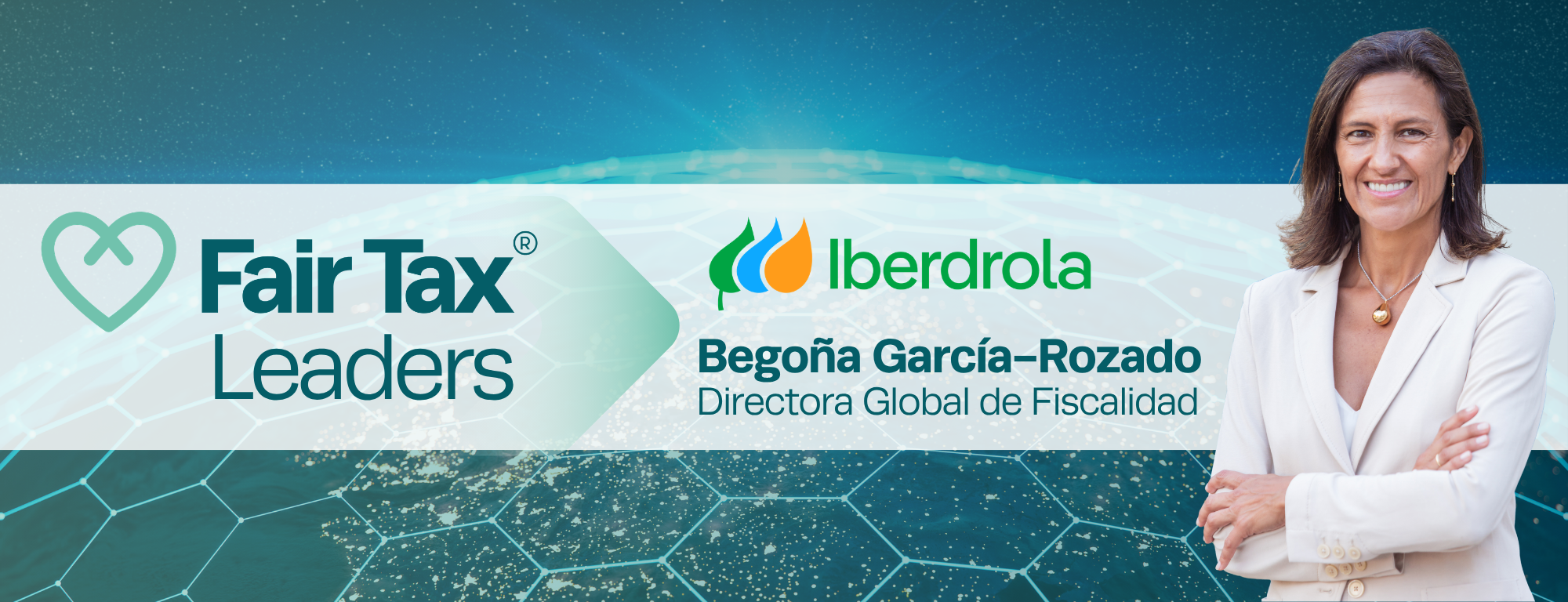
Fair Tax Leaders features senior professionals from across the Fair Tax Mark business community.
Here, Begoña García-Rozado, Global Head of Tax of Iberdrola Group, shares Iberdrola’s tax team transformation, why she sees tax as a corporate responsibility and why stakeholders will keep demanding greater transparency.
Iberdrola are a global energy leader in networks, storage and clean energy, supplying energy to 100 million people. They are the leading utility in Europe and the second largest in the world by market capitalisation, and were the first Spanish multinational to obtain Fair Tax Mark accreditation in 2024.
What first drew you to work in this field and how did you come to work in your current role?
My professional career has always been closely linked to the field of taxation and to the international institutional and corporate environment. I am a State Inspector of Taxes, Customs, and Special Duties, currently on leave, and my time at the Ministry, where I held various responsibilities, was key to understanding the role of taxation from a public service perspective, grounded in technical rigour and legal certainty.
Throughout my career, I have taken on increasing levels of responsibility, allowing me to develop a global perspective on the tax function and on its role in creating value and fostering trust, both within organisations and across society as a whole.
As Global Head of Tax at the Iberdrola Group, I lead an international function that is fully embedded in the Group’s strategy, with a strong commitment to professional excellence, ethics and transparency.
How has the role of the tax team changed in this time, especially in relation to stakeholder expectations around fair tax and corporate transparency?
Over the past few years, the role of the tax team has undergone a significant transformation. At Iberdrola, the tax function is no longer viewed merely as a cost centre or as a function focused solely on tax compliance; instead, it has become a strategic area embedded in business decision‑making and value creation, with a key role in promoting responsible tax practices, accountability and transparency.
Stakeholders expect responsible tax management that is consistent with the company’s real economic activity and supported by a high level of transparency. In this context, our reputation has become our most important intangible asset, and Iberdrola’s tax team plays a key role in protecting and strengthening it, contributing to good governance, the creation of sustainable value and the building of trust through transparency practices that go beyond legal requirements, such as the voluntary publication of our Tax Transparency Report.
What drives your business to pursue responsible tax conduct and gain the Fair Tax Mark?
A deeply held conviction: taxation is an essential part of our contribution to society and a key component of our social dividend. The taxes we pay in the countries where we operate directly support public services, economic development and the prosperity of the communities in which we are present.
We view taxation not merely as a legal obligation, but as a corporate responsibility closely linked to our values, to our real economic activity and to the creation of sustainable long‑term value.
Obtaining the Fair Tax Mark reflects our commitment to strengthening that trust by subjecting our tax practices to an independent external standard, which demonstrates our commitment to fair, responsible and transparent taxation aligned with international best practices.
What would your advice be to other professionals who are thinking of applying for the Fair Tax Mark?
Fair Tax Mark accreditation should be understood as a process of internal transformation and the consolidation of good practices, rather than as a one‑off external positioning exercise.
For it to have real value, responsible tax conduct must be fully embedded in corporate culture, governance systems and decision‑making processes, forming an integral part of the company’s business model and good governance framework.
The Fair Tax Mark demands rigour, consistency and long‑term commitment, but in return it offers a valuable opportunity to strengthen credibility, stakeholder trust, and the role of the tax function as a driver of value creation and good governance.
What are your thoughts on the future of fair tax and corporate transparency?
Responsible tax practices and corporate transparency will continue to become firmly established as key elements in the years ahead, driven both by evolving regulation and by increasingly demanding stakeholder expectations. Stakeholders are calling not only for compliance, but for consistency between companies’ real economic activity, their tax contribution and the information they disclose.
In this context, tax transparency will cease to be a differentiating factor and will instead become a standard of good governance. Companies that embed responsible tax practices within their culture, governance systems and value‑creation strategy will be better positioned to build trust and to contribute sustainably to economic and social development.
What one sentence would your team use to describe you?
That’s a tricky one! I would like them to say that I try to be a fair and ethical professional, someone who recognises effort, values merit and leads by example.


