
Ireland leads the way: Time for an EU-wide pCbCR register

Multinationals publishing mandated reports through Ireland’s central register show markedly better public Country-by-Country Reporting (pCbCR), the Fair Tax Foundation’s latest research finds.
Of the 66 reports (as at 12 November 2026) in the document library of the Companies Registration Office (CRO), we assess 91% to be fully implementing or going beyond the EU pCbCR Directive’s requirements. The equivalent figure across the whole population of our wider database, covering 942 multinational enterprises (MNEs) reporting under the Directive, is 57%.
This analysis builds on our October research update, which covered 650 MNEs, and examines whether the way reports are published could help explain differences in disclosure quality.
Ireland’s CRO collects reports in a free, browsable document library, while our database draws on reports from a wide range of sources. When we look at what might explain the gap between them, earlier filing timelines in some Member States may account for part of it. Beyond that, we see two explanations that can work together: more transparent groups may choose to file in Ireland, and a free, central register may encourage fuller disclosure.
The Fair Tax Foundation believe the CRO’s document library to be a great example in practice and would encourage the EU to consider mandating a freely available central register for published reports.
What does the data tell us?
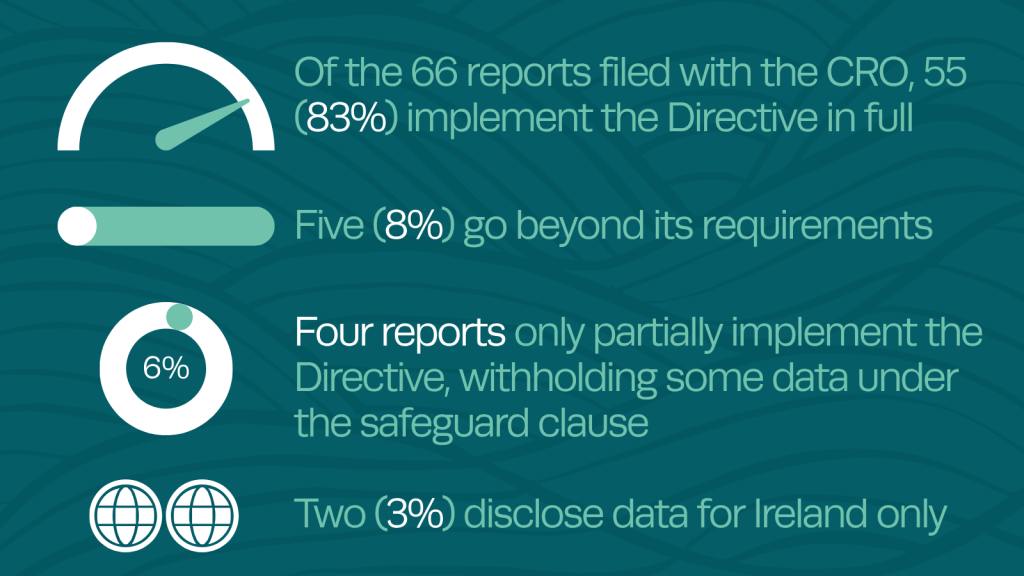
Of the 66 reports filed with the CRO, 55 (83%) implement the Directive in full, with a further five (8%) going beyond its requirements. Four reports (6%) only partially implement the Directive, withholding some data under the safeguard clause. The remaining two (3%) disclose data for Ireland only.
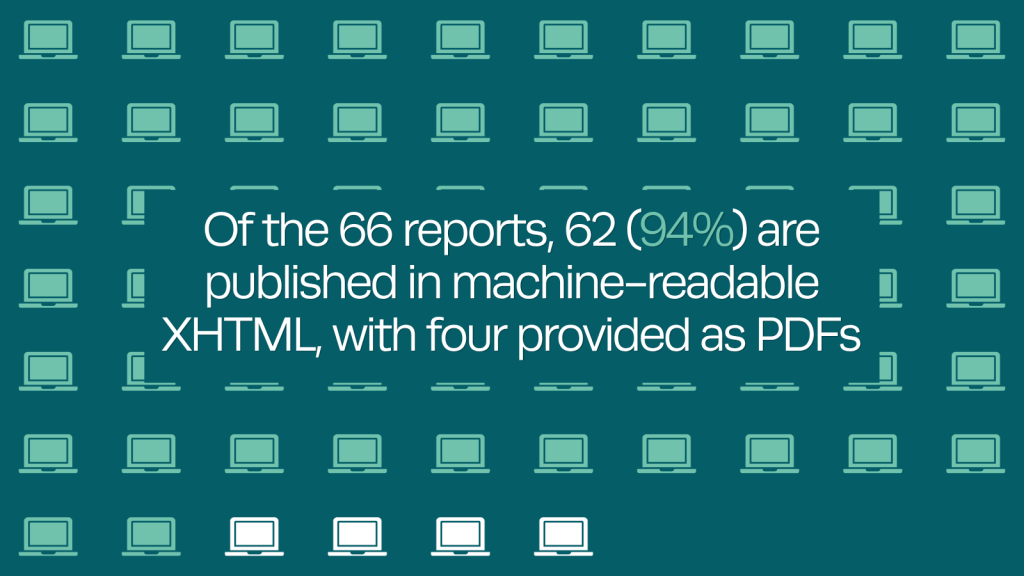
Of the 66 reports, 62 (94%) are published in machine-readable XHTML, with four provided as PDFs. Reporting of this type makes it far easier for researchers, investors and civil society organisations to extract, analyse and compare corporate tax information across jurisdictions and MNEs.
Explaining the gap
Only five of the 66 reports have been filed by groups with Irish parent companies, which are required to file in Ireland. For most groups using the CRO register, where a report is filed is, to some extent, a matter of choice. This is because MNEs headquartered outside the EU can generally file their report in any Member State where they have a subsidiary or branch (provided the parent company also publishes the report on its website, free of charge).
That choice provides one possible explanation for our findings: self-selection. Groups already committed to meaningful tax transparency, with little concern about making disclosures readily accessible, may be more likely to choose Ireland. The higher proportion of full or better reports could therefore reflect which MNEs file there, rather than the publication system itself.
Alternatively, a single, publicly accessible register could prompt better disclosure quality by making reports easier to find and compare. Side-by-side scrutiny makes omissions and deviations from the Directive more visible. It may also influence whether MNEs use the safeguard clause or other methods to withhold data.
The two explanations could even reinforce one another: more transparent groups may favour accessible registers, while the prospect of greater public scrutiny may shape what they disclose.
There may be other issues at play, including differences in how the Directive is being implemented across Member States. For example, Romania and Spain have start dates or filing deadlines ahead of the rest of the EU, and some groups reporting there publish single-country data only at the time of writing, pending the reporting obligation becoming applicable across all Member States.
Untangling these factors is not straightforward, but the gap in our findings is too large to dismiss simply because the reason cannot be easily identified.
Australia
Australia offers a further point of comparison with the EU’s approach. Under its pCbCR rules, in-scope MNEs submit reports to the Australian Taxation Office (ATO), which publishes them centrally on the Australian government’s data.gov.au platform.
As of 12 November 2026, a first batch of reports has been made publicly available, with data being collated into one downloadable spreadsheet, which makes it easier to analyse at scale.
However, Australia is not a like-for-like comparison. Data can be withheld from pCbCR reports only with the ATO’s approval on a case-by-case basis, whereas EU rules allow data to be withheld without prior approval in many Member States (for example, by applying the safeguard clause).
What are the implications?
Our findings suggest that the effectiveness of the EU’s pCbCR rules may depend on how reports are published as well as on what MNEs are asked to disclose.
As the regime unfolds, the EU should consider a freely available central register, which would make reports easier to find and compare across Member States. Ireland’s CRO document library offers a working model for that discussion.
For full analysis, company ratings and latest data, visit the Fair Tax Foundation’s pCbCR Resource Hub.
To learn more about public country-by-country reporting, read our guide: Public Country-by-Country Reporting: Why and how multinationals should lift the lid on their taxes
For access to our detailed database of MNEs and their public reports, please contact us directly.
Email: [email protected]
Telephone: +44 (0)161 250 6595


